Rafi’s Run and Helping Butterfly Children

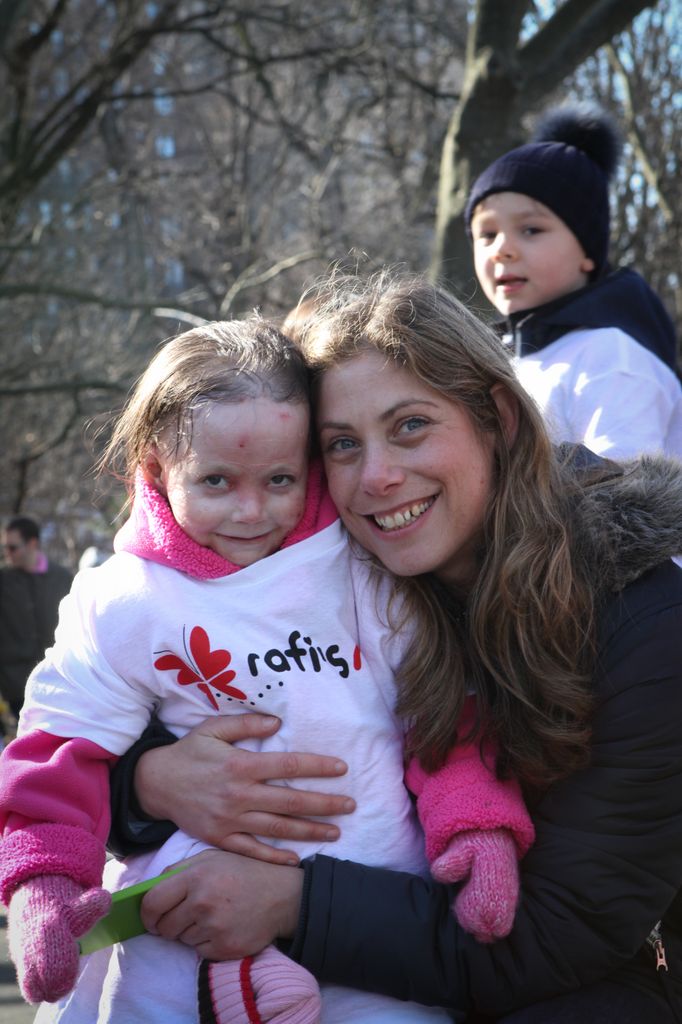
Last year I met a very cool mom, writer, and actress named Wendy Stetson at a blogging event. Because we share a very cool name, we had a lot to chat about. It turns out that Wendy and I have a few friends in common–and I learned that Wendy and these friends are committed to helping a brave, strong, and adorable six-year-old girl named Rafi, who lives her life in constant unimaginable pain.

Rafaella Lily was born with a severe form of a rare genetic disorder called Epidermolysis Bullosa (EB). Two years ago, a group of moms from Rafi’s preschool got together to make a difference for Rafi, and children like her. Rafi’s Run was created because there is currently no cure for EB. There is not even a treatment to minimize the pain.

Often referred to as “The worst disease you’ve never heard of,” EB is a devastating disorder which causes children’s skin to be so fragile that simply scratching an itch results in blisters and tears. Kids with EB are known as Butterfly Children, because their skin is as delicate as a butterfly’s wings.

rafjack

Rafi’s Run raises money to fund research for a cure for EB; thanks to the generosity of family, friends, and businesses, $400,000 has been collected for the cause. Every penny donated to Rafi’s Run goes directly to researchers who are already making amazing discoveries that will benefit not only kids with EB, but also children with similar disorders.

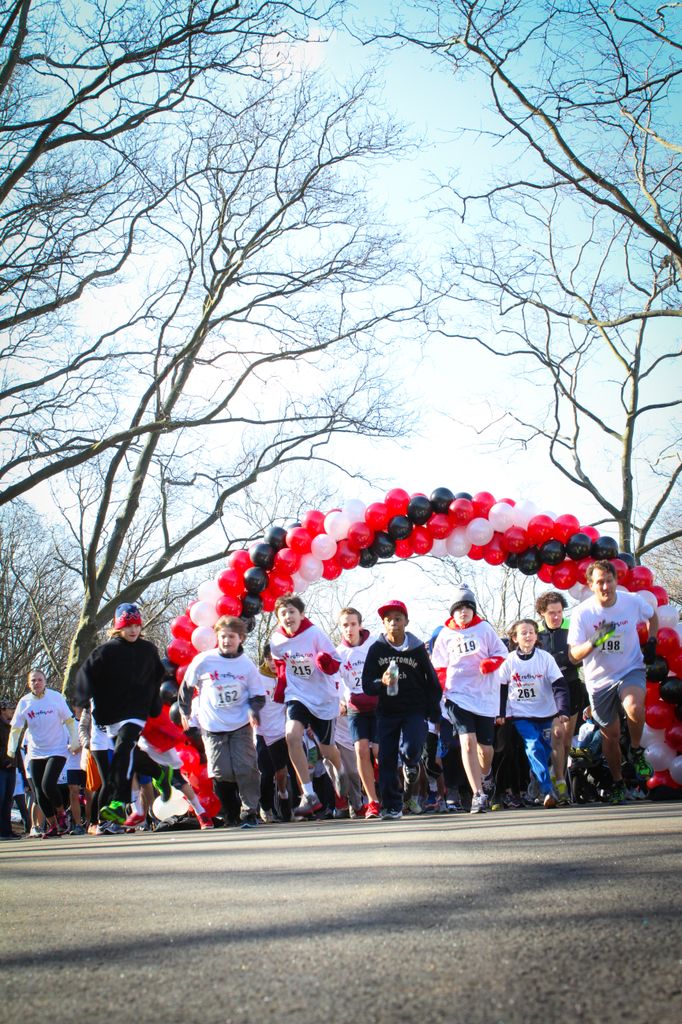
The run has elicited a tremendous outpouring of community involvement and national attention. The Third Annual Rafi’s Run Should be even bigger than the first two. The 2014 5K Run/Walk will take place in Riverside Park at West 103rd Street on Sunday March 9th, at 10:00 a.m., with a Children’s Fun Run at 11:00 a.m., for kids ages 12 and under. There will be a raffle and snacks, a musician, and a big green dinosaur; and everyone goes home with a very cool tee shirt. All donations are fully tax deductible and go directly to researchers via DebRAof America–the premier nonprofit organization for research into treatments for EB.

Please be a part in helping to find treatment and a cure for EB. Visit Rafi’s Run to learn how you can volunteer, participate, and support this really wonderful event.

rr13-17 rafisrunkids

Posted in Event, Family Life, New York City Living and Coping, Parenting Moments | Tagged , , , | Leave a comment

Being a Mom With Food Issues

We all knew women in college with issues around food–anorexia, bulimia, compulsive eating, women who didn’t eat so that they could drink more. Maybe you were one of those women to a degree, or maybe you lived with a roommate and know too well about eating disorders from that experience. I was one of those women, although my eating disorders started long before college.

Last week my friend Tracy Morrison wrote a heartfelt letter to Nordstrom explaining why a pillow for sale in its stores, meant to be cute, was spreading the dangerous message to girls that skinny is good, skinny is always the goal. The letter went viral, and Nordstrom removed the ridiculous pillow from its shelves.

It took Tracy tremendous courage to take on this topic–as well as a giant retailer–and to share her own story. What occurred to me as I watched so much support well up around this feat, is that so many moms are likely dealing with their own battles around weight and food and obsession. There is no expiration date on eating disorders, yet it is not something we acknowledge in the mom community in the present tense. Perhaps this is because we think these are issues we should be over “by now.”

We write and talk a great deal about making sure our daughters have a healthy body image; that they see past what the media serves up–flawless and impossibly proportioned women; that they play with Barbie without assuming she represents an ideal; that they look to movie characters who are strong and self-sufficient instead of meek and in need of rescue.

As a mom of two girls and one boy, I think of these things too. I don’t comment on my weight or anyone else’s. I don’t say I feel, look, smell, or sound fat. I compliment the kids on their clothes, their hair, their ideas, their good memories and their great questions, their athletic ability (or ambition), their schoolwork, and their compassion. I redirect conversations that begin with “I look….” I treat them like the whole persons they are.

But I am thinking about my weight most of the day, every day. I weigh myself so often that I know what each article of clothing I own weighs. I know how much my shoes weigh. I have two scales in case I need a second opinion. There are medications that have helped, or would help, my anxiety that I refuse to take because they are likely to cause weight gain. As insane as that sounds–as insane as that is–it won’t change because I wish it were different, or I pretend those aren’t my thoughts. Yet I am a world away from where I began, from a place to which I don’t want to return. Along with mountains of gratitude, I harbor shame and fear, still, in bringing this up.

My children didn’t know me when I didn’t eat or when I exercised compulsively, or when I got up in the middle of the night to binge on whatever was in the cabinets. They don’t know the measures I went to to be thin and thinner. Because I have worked very diligently–but not perfectly–over the past decade-plus, they do not need to ever know that woman.

There are few times in my adult life that I have spoken with friends–certainly not new friends–about my past struggles or the struggles I continue to have. Few people have shared their problems around food with me. So many times, however, have I seen a woman, around my age, clearly in trouble (as this can be a very visible disease) at the gym, in a store, or somewhere else; I have never approached anyone. Eating and body image issues are not cool when you’re in your forties, and I don’t want to expose another person to her embarrassment. Or my own.

After Tracy’s victory, I had a thought: Given the enormity of the eating disorder problem in colleges, is it possible that all these young women are recovered by their thirties and forties? I think that of those of us who survived–because some do not–many found solutions, or were able to leave it behind. But I think many are still at the mercy of the disorder, and some have developed eating disorders later in life. As grown women and mothers, we may not know there are support systems or even feel we deserve one at this point in our lives. It can feel like defeat because this is an indefatigable opponent.

I wish though, that we didn’t have to hide our battles from one another. I wish we could say that you aren’t bad if you have these thoughts and feel powerless around food, or compelled to exercise, or hate yourself when you aren’t a certain number. You aren’t a failed mom or woman because you cannot control your thoughts in the face of all the colors of information about nutrition, healthy living, acceptance. You probably have a problem that you cannot solve with your own thinking. Living like that isn’t the answer. But as someone who has spent many years in the illness, and many years in recovery, I know that, alone, I couldn’t imagine or read or wish myself out of the cage. The belief that we should know better when we are parents, keeps women (and men are not immune) from seeking the help that is most certainly out there in the form of anonymous programs, in- and out-patient treatment programs, and therapists that specialize.

I walk the line every day between wanting to protect my daughters from unnecessary influences on their pliable self-esteem and having my own mind with the fallout from twenty years of active eating disorders. That line may will always be the thinnest one in the room.


This post appeared originally, with a slightly different title, on Appleseeds blog.

Posted in Family Life, It's All About Me, Mental health, New York City Living and Coping, Parenting Moments | Tagged , , , , , , , , | 1 Comment

A Special Kind of Attention

Early one recent winter morning, my four-year-old son came barreling into my bedroom. It was still dark outside, and the heat in our apartment was cranking up; the pipes in the bathroom banged on and on.

“Mommy, would you build me a space shuttle? Not like the one we had to color on, but a small one that blasts into space?” he asked.

My husband slept soundly even as Henry spoke in his loudest inside voice, and the tings from the heating grew in volume and frequency. “Henry, it’s still dark. Come lie down,” I requested, knowing he would not.

“NO! I want to go to the living room! Come! NOW! Come!”

The possibility of him waking his two sisters was great and familiar, so I dragged myself out of bed and onto the living room couch while Henry threw question after question at me: “Why is the moon shiny?” “Why is it still dark?” “Why are the leaves not on the trees?” “Why are the trees moving?” “What is the wind?” “Why is it nighttime and then morning and then nighttime?”

Finally, I turned on the television.

Henry gets a special kind of attention. It begins in these early morning hours and lasts until bedtime. Preschool has worked wonders for him — his vocabulary has improved, he is becoming more independent from his twin sister in social situations, he can express his thoughts with less hesitation.

His compulsive habits, however, still indicate his frustration with daily tasks — getting dressed by himself, putting shoes on quickly so we can leave the apartment, writing his name within the lines. He repeats himself: Mommy, I said don’t help me! Mommy, I said don’t help me! Mommy, I said don’t help me! Mommy, I said don’t help me… Or, depending on his mood: Mommy help me! Mommy help me! Mommy help me! Mommy help me… He throws books or toys or his rain boots when we don’t understand what he wants.

But that is some of the time. Much of the day, Henry is he is determined, sweet, curious, and funny. His teacher adores him. It’s when he is tired and unable to do one more thing that he breaks down. And with our days being back and forth to school with little down time, I understand this.

We humor Henry a lot. I tell the girls to just “Answer him!” or give him at toy he wants or let him sit in the stroller. I try hard not to do this; at the end of a long afternoon, when everyone has had enough, I want more than anything, control and peace. These are unrealistic expectations of my children and myself. The fault is not with them.

Last night we took the kids out to dinner. One of the girls wanted to go to a restaurant “we’ve never been to before.” Henry stood next to the table after screaming his dinner of macaroni and cheese was disgusting. He cried that he wanted to go home to eat. We tried to get him to sit down, but he refused. As the restaurant filled up, other diners turned and stared.

To avoid a meltdown we wouldn’t be able to stop, we let him stand quietly wherever he wanted. I would not have allowed either girl to do the same, I know this. “Please,” I say to them, “just behave and eat your dinner. Sit in your chairs and stop fighting.” And this, combined with threats of no dessert, works with them.

It would be terrible and cruel and untrue to say that I prefer one child over another. I do not treat them identically, and they know this. The world — our little world — is imperfect, less fair, not immune to pettiness. I hear often that I am being “unfair” and “mean,” that I don’t love the one who is complaining. And that one is usually one of the girls. I expect them to have insight into our family’s complexities.

What my children don’t know, and won’t fully understand until they have their own, is how each one has the whole of my heart. When I check on them at night while they sleep, kissing each on what skin is left exposed by pajamas and blankets, there is no different child, no difficult child, no expectation of one or the others. There is only my gratitude, the silent darkness in the room they share, the endless potential of each sleeping child

This post appeared originally on WhatToExpect.com with a different title.

Posted in Family Life, It's All About Me, New York City Living and Coping, Parenting Moments | Tagged , , , , , | Leave a comment

Getting the Unexpected at a Parent-Teacher Meeting

The hallway outside my oldest daughter’s first grade classroom is wallpapered with the children’s colorful work. I am waiting with other parents for our “parent teacher conference,” our ten minutes to learn how our child is adjusting. This year, I know so much less of what she does at school. I am giddy from the excitement of speaking for the first time with her teachers, and from being out on a weeknight.

I search for my daughter’s recent writing project among the many—stories about vacations and meals and cars and pets, all accompanied with drawings. My daughter has written about a trip to grandma and poppy’s house.

Her story is about, Cleo, the pet bird. How he scared her with his loud squawking, and she cried because of it. “Stop crying!” mommy said.

“Oh, that’s not good!” I laugh to the other parents.

And there is an illustration of mommy underneath the words: “Stop crying!”

That’s really not good, I think, growing slightly uneasy as I realize she may actually tell people how much I yell. The parents and I joke about the crazy things that kids say. I suddenly have a steel ball in my stomach.

 The teachers run late. I look among the hallway projects, their staples coming loose from parents’ pulling in order to read what our six and seven year olds are thinking.

Every year, twice a year, I hear how lovely my daughter is to have in class. She’s kind and smart. I love talking about her with her teachers. I am sure I will be calling my husband at work to tell him about the glowing report I received.

I am called to the room. One teacher asks quietly, “So who is Mollly?”

“What?” I asked. He spoke in a tiny whisper.

“Exactly.”

I learn that my daughter doesn’t speak in class. Not a word to the teachers. Barely a word at all. She asks other students to help her when she needs something. She never addresses the two teachers in the room, and she doesn’t respond when called upon.

“We want to hear her voice,” I am told, and: “We think she’s scared of making mistakes…that we’ll yell at her.”

I can’t believe what I’m hearing. A fear I had not vocalized outside of a therapist’s office—that my reactive anger at home will hurt my kids—is sitting in front of me. And I don’t have time to digest this.

“And of course we wouldn’t!” her teacher continues.

Immediately, I blame myself. I expect too much at home, and put pressure on her to not make mistakes. And I scream often over the mistakes—the messes that aren’t picked up when I ask, the spilled water on the table, all the little things that fill our days.

I remember being afraid to speak in class. And terrified of my answer not being the right one. I still get flush and my heart pounds when I have to speak to groups. And my husband is hardly better.

She inherited our shyness. How much of her silence in the classroom is her genetic bounty? How much is from “Stop crying”?

Molly has never said she doesn’t want to go to school in the morning—something I did regularly as a kid. She loves school. Each year, she starts out quiet. After a few weeks, she is more comfortable participating. I am baffled that she hasn’t warmed up to her teachers by November.

“I’m a perfectionist,” I admit. I want to say. I think of her story and drawing in the hallway. “And she’s really loud at home!” I added. Because she is really loud at home.

Her teachers look surprised when I share that she’s very vocal and active at home. Do they believe me? Are they also blaming me? Or are they just tired and want to get home?

My guilt is that of a mom who is trying. With three little kids at home, there is a lot of yelling. I put unreasonable demands on them at times—to behave better, clean up sooner, keep their voices down. I scream when they take too long getting ready and I am forced to repeat myself. I scream when I feel I’ve lost control over them, or the situation. To them, it must seem to come from nowhere. For me, it is a constant struggle to keep everyone on track and not sound like a dictator and sometimes worse. Evolving into a more patient mother is a slowly traveled road. Progress, as much as we’d like to simplify it, is more than just a decision.

My children may not see the progress yet, however—only the problem.

In the morning, before school, I tell Molly her teachers think she’s wonderful, but they want to hear her ideas. They want to hear her voice.

Little girls must learn to speak up and speak out for themselves. I thought I was teaching my two girls, and my boy, that. “You have to ask for what you need.”

“Ok mommy. I get scared to talk.”

“I really want you to raise your hand and participate in class. It doesn’t matter if you make a mistake. No one cares about that.”

“Ok. What does ‘participate’ mean?”

A couple of weeks later I observe her classroom, all of us parents scrunched into tiny chairs or standing against the wall honing in our child. Watching for clues to who he or she is and is becoming.

And Molly raises her hand. Once. And she answers when she’s called on. And she moves with the class during their dancing exercise. Her answer was wrong, and later she tells me she did a “jump” the opposite way during their dance. I assure her it is fine.

The relief loosens my breathing. I report the good news to her father. Perhaps I was wrong or exaggerating, or maybe I am letting myself off the hook—but I am impressed with Molly’s progress, which like my own, is in small increments. She is learning to speak her voice. And I am listening.

This post appeared originally on WhatToExpect.com titled “My Daughter’s Teacher Gave Me Bad News and I Blamed Myself.”

Posted in Family Life, It's All About Me, Mental health, New York City Living and Coping, Parenting Moments | Tagged , , , , , , | 2 Comments

A Lesson in Change

Tonight while reading her book for school, Dancing Dinosaurs, my first grader asks how people came to be. Last week, we watched the short introductory film at the American Museum of Natural History explaining the common origins for all vertebrates. We watched it five times.

Doing her homework, which was to answer questions about the books she reads, she asks how humans came to live on earth. I attempt an explanation, “Humans have been evolving over millions of years–from the first creatures that crawled from the sea. Remember that in the movie? The first human beings didn’t look like we did. Scientists believe we evolved from other primates, like apes, over many, many, many years.” Is that right?

“What?”

“Well, evolution is complicated. It means living things and the earth have evolved or changed over millions of years… You know dinosaurs didn’t really dance, right?”

“Yes, I know that. I think God put two people on earth and then a baby in the woman’s stomach.”

What the? “What? Where did you hear that?”

“Nowhere.”

“That’s a very religious way of believing how people came to be. Some people believe that. I think it’s a nice story.”

“I wish you knew more about people.”

“No one knows everything.” I’m trying.

And then I see that she has circled in her homework log “Poetry” as one of the genres she has been reading at home.

“Molly, you haven’t read any poetry. Why is it circled?”

“Yes I have! See?” And she opens the Dinosaur book to first pages. “See? It says ‘Poetry of…'”

“That says ‘Property of.'” Oh my God. “We don’t really have any kids’ poetry, but most of the books on the shelves are poetry books. Mommy really loves poetry.” Strangely, I haven’t bought any for you.

“Can we read one?”

“Yes,” I say. I pick up a favorite, Eavan Boland‘s collection The Lost Land. Thumbing through, I find “Daughter,” and then rethink it, and say that it’s too long.

“No, I want to hear it!”

“Okay. This is a poet who writes about growing up in England and Ireland. She writes a lot about history.”

“Okay.”

“This poem is called ‘Daughter,'” I read:

I. The Season

The edge of spring./The dark is wet. Already/stars are tugging at/their fibrous roots:

In February/they will fall and shine/from the roadsides/in their yellow hundreds.

My first child/was conceived in this season./If I wanted a child now/I could not have one.

Except through memory./Which is the ghost of the body./Or myth./Which is the ghost of meaning.

II. The Loss

All morning/the sound of chain saws./My poplar tree has been cut down.

In dark spring dawns/when I could hardly raise/my head from the pillow

its sap rose/thirty feet into the air./Into daylight. Into the last of starlight.

I go out to the garden/to touch the hurt wood spirits./The injured summers.

Out of one of them a child runs./Her skin printed with a leaf-shadow.

And will not look at me.

III. The Bargain

The garden creaks with rain./The gutters run with noisy water./The earth shows its age and makes a promise/only myth can keep. Summer. Daughter.

“Why is the body a ghost?”

“Well memory is like a ghost–it exists outside the body. After the body. It doesn’t change or grow up or grow old.” You know it is there beyond the touch. “She can remember her daughter when she was little, even though she’s grown now. Did you like that?”

“Yeah.”

“I’ll buy you some poetry for children. These are really for adults.” 

“But it’s ‘Daughter,'” She says back to me. “It’s for me.”

“Yes, but it’s about a daughter. Written for adults to understand.” Written for those for whom a night with questions and books and markers at the dining room table will slip in a few years–that insignificant measure of time on earth–into the specter of childhood, to wait in the bones of memory. 

Posted in It's All About Me, Parenting Moments, Poetry/fiction | Tagged , , , | 6 Comments

When You’re Married to a Writer

And you get a big rejection of a piece in an email while together you’re watching The Colbert Report, so you go into the kitchen and cry like a baby, and say “Nothing,” when your husband asks what’s wrong, and you open some more wine because that seems like the best you could do right now, and you’re still crying looking at the traffic on the street below and your own reflection in the window with the glittering lights of downtown in the distance, and you’re surprised you’re crying the kind of crying where words don’t come out, and you wonder what the hell you were thinking and why even bother, and that maybe you should just fuck the idea of being a writer because, really, the past 20 years should have told you something unless you’re just dense, which maybe you are, and you think, shit, I have to make lunches for tomorrow and check on that playdate and confirm the sitters for the rest of the week, and you’re grateful the wine is cold, and you’ll probably get over this because there’s really no alternative is there but to fucking forget it, and tomorrow is another day with the computer and the kids and getting back to friends about plans for rescheduling dinner soon, so be sure to charge your phone overnight, maybe you shut down Word, and watch the lights in the distance for a little longer, the plane flashing by, the stars that flicker.

Posted in It's All About Me, New York City Living and Coping, Writing | Tagged , , , , | 10 Comments

Upon a Spotted World

There are the days I retreat. Those days I am particularly sad and feel raw to the world. A high didn’t last; I let myself down; someone did something so much better than I did, or would, or thought of doing. There are many days of that color. And few places to hide. My usual time-pass of social media can be a tough stay: this ain’t no place to fall behind (from The Weary Kind, Ryan Bingham). Even with the pretty pictures. Those days, I do not go on Facebook. 

I am aware that now, in my forties, I no longer try to seem perfect. If I did, I would not write about my raging against my children, or my struggles with depression, anxiety, and body image issues. I wouldn’t write about my drinking too much, and drinking alone.

Once, and for many agains, I chased perfect across the field that expands just as I am reaching its end. Like in a dream, I could not stop running at it.

And when I realized I would not reach it, I tried to act it, to convince people I am someone other than who I am. And who I am, or was–or am sometimes–is ashamed, and scared, and teetering between normal and panicked.

There was a time I was only afraid. And then a time I was strangely, falsely brave. Because I was still pretending and leaning on groups and people I had met in recovery places. Perhaps that was okay for then. It got me through, after all.

When I started to write again, many years after graduate school, a few years after the kids, I found a way back through the fear and shame and delusions which held me up. I wasn’t looking to go back. So perhaps it found me.

I shake when I write about my anger with my children. I shake when I try to write more, the story, the yesterdays, the today, the tonight, and what I hope for tomorrow. What I fear for tomorrow slams me. There would be no purpose I can imagine or hope for, though, other than to believe intently and with humility, not that writing the truth will restore me, or heal me, or heal my children, or my past–but that documenting this will also reveal something beautiful. Or just someone better.

When I wrote about the rage I have felt, the continuum of motherly love, adoration, irritation and anger, there were responses that floored me with their own honesty, kindness, and brutal self-shaming. There are mothers behind those comments who are also hurt and hurting, and who didn’t think they could speak aloud about becoming so angry, so quickly.

I do not try to seem perfect. Not anymore. But down in the deep I may be, still, trying to be perfect. And when I sit facing the words of devastating imperfection, dotting the screen by own fingertips, I am driven to push harder to be nothing but truthful–and I hope a little funny–for the mothers hammered by their own secrets; for the delight in what’s possible; and to scrawl directly onto the brittle shadow of perfection: “nowhere be afraid.”

(This post’s title and last line are taken from Emily Dickinson’s poem When we stand on the tops of Things.)

Posted in Family Life, It's All About Me, Mental health, New York City Living and Coping, Parenting Moments | Tagged , , , , , , , | 4 Comments

Minted Artists Bring Color and Craft to Your Holidays

I am always looking for ways to impress my friends with something different. You have heard me say, however, that I have little imagination for gift giving; so when I find something special, I enjoy a little boasting, and the credit with which it comes.

I have spent the past few weeks (or longer) obsessing over the designs from the Minted artists. Minted connects the world’s independent designers and artists through technology with consumers like me–often far, far away.

I stayed up one night going through hundreds of  holiday card designs. Because I procrastinate, and I am a little lazy, we send out very few cards out each year (so don’t expect one). But I did choose a beautiful retro-themed design for a “Happy New Year” greeting. Our mail carrier, building porters, and my husband’s one aunt will be delighted to receive this one!

You can find anything you need for wedding invitations, thank you notes, baby and kid stationery, business correspondence, calendars, and much more on Minted–with many exciting choices regarding printing and paper options. The experience of looking through the designs did make me miss–in many ways–the time when we could only stay in touch with friends and family through phone calls, and lovely cards and letters (I am that old, folks).

Luckily, now that I can be reached on email, Instagram, Twitter, and Facebook, I have stunning new business cards with this information to flash around at cocktail parties this holiday season (also, my mail carrier, building porters, and my husband’s one aunt will be thrilled to receive one with their new year’s card!).

(Our holiday card is pictured with Starbucks grande latte. Latte is not included. But it too is part of the “Most Wonderful Time of the Year.”)

mintedholiday

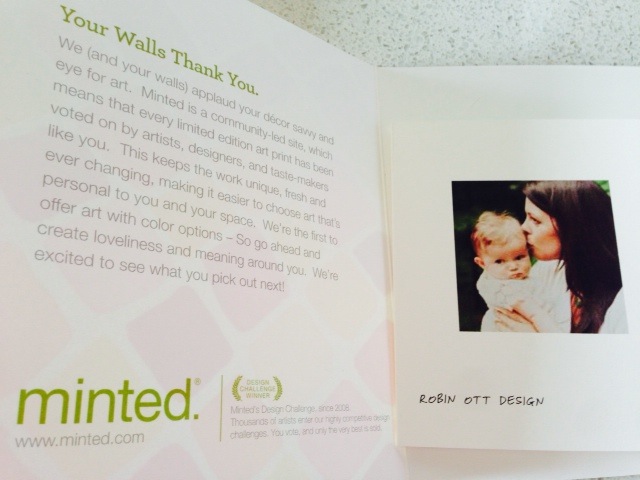
mintedbusinesscardsOne of the coolest thing about this experience was getting a card from the artist whose design I chose for our family collage. The designers, like Robin Ott, submit their work for voting in a competition. The winners’ designs end up in homes around the globe.

minted artist

minted wall hangingI meant to post this review weeks ago. It took me so very long to decide among the beautiful stationery, business card, holiday card, and wall art designs–and then I had some difficulties uploading and saving my photos to the website. Minted’s customer service responded immediately, and each of two times was able to help fix the issues (which may have been mine).

Once my mind was made up, and my order finally placed, I did not have to wait long for it to arrive well-protected with friendly notes letting me know who packaged my order.

Visit Minted’s website to see what special offers are available right now. Start impressing your own friends with the many unique gifts, cards, art, and more from independent artists across the world.

I was provided with a Minted credit to use to place my order; I chose my own products. All opinions are, as always, my own.

Posted in Family Life, New York City Living and Coping, Review | Tagged , , , , , | Leave a comment

The Part of Parenting We Don’t Talk About

(This post was written for and originally published on WhatToExpect.com with the title “The Part of Parenting We’re Too Embarrassed to Talk About.”)

Occasionally a post circulates the Internet in which the author describes witnessing a mother in the midst of a public tirade against her child or children. The mother may have screamed in a way that could only be an overreaction to a small child’s mistake or incessant crying. Maybe it was in the checkout line. Or a parking lot. Or at a coffee shop or on a bus. Maybe she grabbed an arm too hard and in anger, or slapped her child’s face. She embarrassed him. She may have threatened to hurt him.

Everyone watched her lose it. The scene is over the top. Someone should have come to that child’s rescue. Everyone reading the story agrees. The comments to these posts are unanimous in their condemnation of the parent. She doesn’t deserve children. There are so many good people who can’t have children, what a shame this woman has a child.

I don’t personally know any mother I’ve read about in these posts. I don’t know her story. I don’t know what happens at her home. And I too have been sad and horrified seeing parents scream at their small kids over what seems like nothing.

But I’ve also been that mother in public. I have shrieked at my three children in a voice that doesn’t sound like my own. I have scared them, and attracted the unmerciful attention of strangers. I have dragged my four-year-old son across our lobby floor — screaming at him — into the elevator while crying so that his sister could get upstairs to the bathroom. Old ladies opened their doors to stare at us, at me. The woman losing control with her children.

I have gripped little arms forcefully to get them to cross a busy street in the middle of a meltdown. Someone screamed at me to “calm down,” when this happened. And as I tried to keep my three small children from being hit by cars on a busy avenue, I screeched back, “Fuck off!” None of this came from nothing. We don’t, however, see the intricate movements behind the scenes we witness.

Rage in parenting is not something we talk about. It does not garner the empathy that sadness or apathy does. It is not passive, and it has innocent targets. There are bad parents and there are good parents, along a spectrum. The good ones have bad moments, but those don’t move outside what we can accept as “normal.” No one is perfect. We all lose it sometimes. But what happens when losing it crosses the line from frustration to rage?

I am not talking about abusing and hurting children — when we know a child is being hurt, we must act without hesitation. What I am describing is the build up of resentment and a loss of control that many “normal” mothers experience but can never safely discuss. It’s too ugly, and the risks are enormous. What will my friends think if they know what I’m really like when I’m angry? If I talk to someone, they may take my kids away.

So many of us, with tremendous pressures of caring for family, work, households — often without consistent help — hold on tentatively to the place where all is calm and manageable. Some of us have run from our own chaotic pasts. And when we slip from that place, we fall quickly to where we hardly recognize our own responses. We hate ourselves for being so far less than perfect, less than what our friends are like, that we never even hear of other mothers like us.

And we cope by drinking more, eating more, and sleeping less. There are few acceptable outlets for this honesty that doesn’t fit in. We may put on a show for the world, but we deal with it alone. I spent countless evenings having screamed at bedtime, once the children were asleep, torturing myself for my lack of control, promising I’d get it together tomorrow. I felt unworthy of my children and my life.

My experience with rage began when my first child was born. My irrational anger toward this baby I loved more than I could have imagined stunted me. It took my breath away and planted the seed in my consciousness that I was a bad mother. And when we had twins 19 months later, I truly felt I was an island unto myself.

Although I had known depression before and after children, its manifestation as anger continued to confuse and shame me. My quickly tightening jaw and clenched fists in response to the crying, whining, and never-ending demands of three babies shocked and terrified me. I listened to friends describe their difficult moments with their kids, hoping something would sound familiar to mine, but the disgusting fear that I was unique balled in my stomach.

As my two daughters and son are getting older, are in school now, I am enthusiastically, oddly willing to talk about parenting rage. Where it comes from and how prevalent it is in mothering young children. Mine is not the face of a wickedness, nor are the faces of any of the mothers I speak with. I want to be a better mother. Not the best mother. Not even a mother who never curses. But I seek to understand the cycle of nurturing — what we give ourselves, we also give our children.

When I describe writing about rage, depression, and parenting, I sometimes get blank or uncomfortable faces looking back at me. But more often, I see the eyes soften, and I hear from a similarly evolving soul “Oh, yes, I’d read that.”

Posted in Family Life, It's All About Me, Mental health, New York City Living and Coping, Parenting Moments | Tagged , , , , , , | 34 Comments

When You Least Expect

I sat in the playground this afternoon while Henry and Molly played, reading a new parenting book. The methods and message of the book contrast greatly with how I have been parenting. And that is the point of my reading this book: we need some changes around here, some alternatives to yelling and battling the little things. We need some new ways of thinking.

And I was thinking heavily about what I was reading, feeling hopeful but realizing my mistakes may indeed be grave. I had already made some mistakes today getting them to swim lessons. At one point I put the book down and was talking with Molly on the bench; she wanted to play with my phone. Try to say yes more than no.

Henry came over and without my realizing, took my eyeglasses. And ran with them.

“Look what Henry’s got!” Molly alerted me. Crap. What the fuck does this book say about kids taking things that could break and cost a lot to replace? 

“Henry. Henry!”

The chase began.

“HENRY! Those are my glasses!”

And he threw them on the ground.

“THOSE ARE MINE! Do you want to leave?”

Don’t threaten or reward. Deal with the child and not the behavior. Do not punish or threaten. Ask him what he’s thinking.

“We WILL leave!”

Crying.

Crap. 

I walked away from my son, past the other parents at the park, not making eye contact–as one does in this situation.

Later, I could see another mother approaching my bench. I didn’t acknowledge her until I couldn’t avoid it.

“I just want to tell you,” she leaned in, “that I have been there. With the glasses.”

Surprise.

“And you handled that really well, keeping your cool.”

Really? “You are sweet.” I said something about eyeglasses being easy to break. “Thank you.”

And just like that, I wasn’t a “bad” example. We may both be wrong, this mother and I. We may know more than we think. Or we may just be doing what we can do. Parenting transforms us into our better selves, and often our worst; it changes from moment to moment. These are true. True as well, is that the universe will, at times, fill an empty moment with the smallest of kindnesses.

photo-1

Posted in Family Life, It's All About Me, New York City Living and Coping, Parenting Moments | Tagged , , , , | 10 Comments